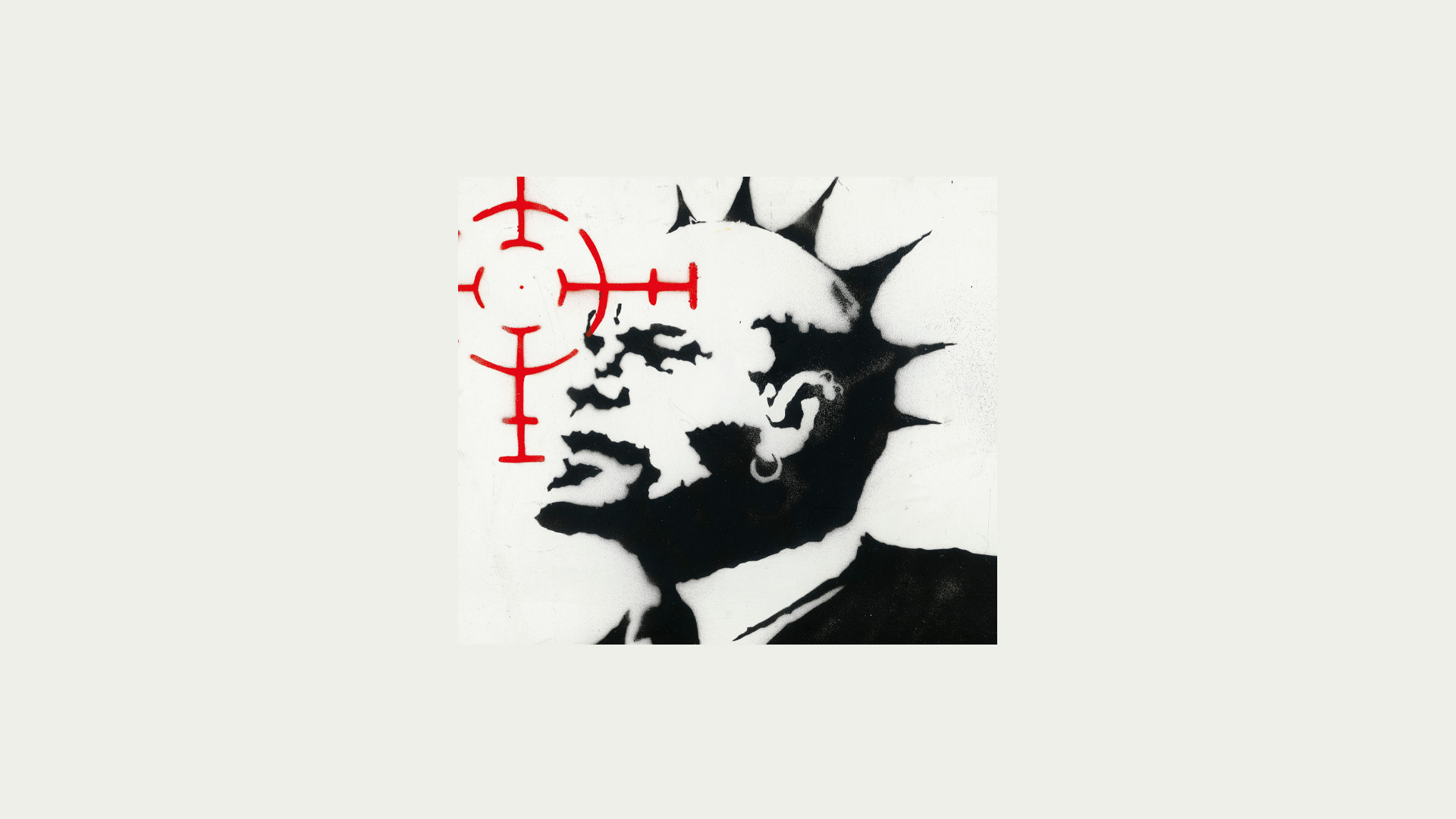
This artwork, dated 2004 and made in spray paint and emulsion on wood, is one of the most direct examples of how Banksy engages with historical figures.
In the image is Vladimir Ilyich Lenin, but not the Lenin we know. The fixed portrait familiar from Soviet iconography has here been turned into a punk: his hair stands up in a mohawk, and there is an earring in his ear. His formal collar and tie, however, remain exactly as they were. So the figure hangs somewhere between a statesman and a street rebel.
Placed over the composition is a red crosshair, lined up exactly on Lenin’s face.
These two overlapping interventions build the whole tension of the piece. Banksy first takes the symbol of revolution and translates him into the language of youth culture, another form of rebellion; the revolutionary ideal is reduced to a matter of style. Then he puts that same figure in the crosshairs. The message runs in two directions at once: radical ideas either turn into a marketable aesthetic, or they become a target. Often, it is both at the same time.
It is no accident that Banksy turned to Lenin. Throughout his career, the artist has placed the great political figures of the twentieth century into contexts that diminish them or bring them down to the everyday.
The piece first passed into a private Asian collection; on 25 May 2021, it came up for auction at Christie’s Hong Kong as lot 220, and sold for 7,450,000 Hong Kong dollars, roughly 959,000 US dollars.
Lenin In Sight is a sharp sentence Banksy builds around a historical face using just two simple interventions: a haircut and a crosshair. Nothing more is added, and nothing more is needed.