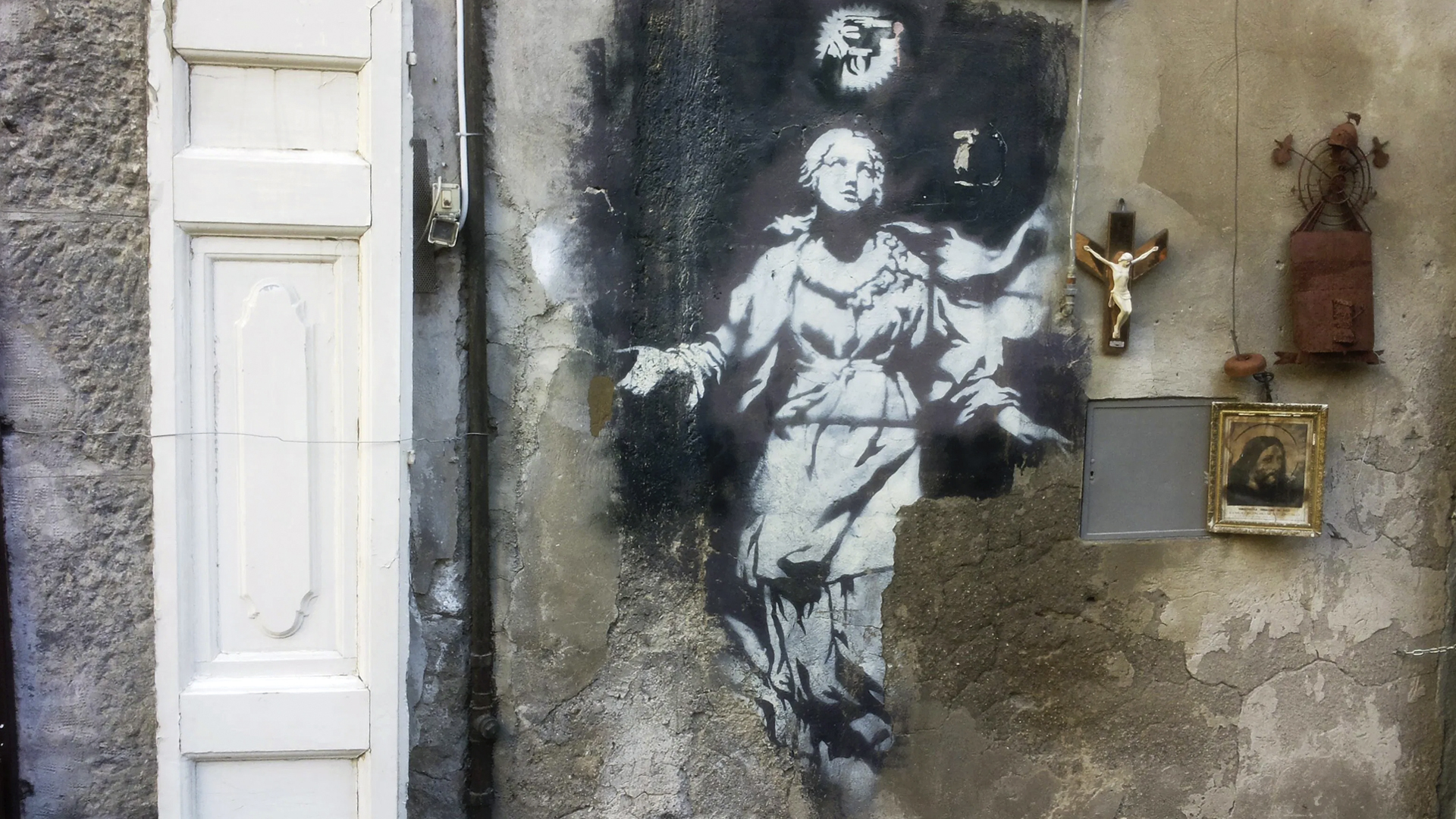
Emerging in 2004 in the historic center of Naples, Italy, Madonna Con La Pistola is one of Banksy’s most iconic and enigmatic works in Southern Italy.
The Virgin Mary, a sacred figure in Naples’ deep Catholic culture, typically represents purity, mercy, and protection. In the mural, she is depicted with an expression true to traditional religious iconography. However, the halo around her head, instead of the customary golden ring, is formed by the silhouette of a revolver, strikingly blending religious iconography with the symbolism of violence. The revolver, associated with power, conflict, and death, creates a sharp contrast with the Virgin Mary’s merciful nature. This contrast symbolizes the intersection of faith and violence.
Banksy critiques Naples’ culture, steeped in religious imagery, and the undercurrents of violence deeply embedded in its social landscape. Naples has historically been marked by mafia violence and social conflicts. The revolver as a halo questions the role of religious institutions and faith in cycles of conflict and power.
The piece prompts viewers to reflect on the meaning of faith and the sacred in the modern world, and how these sacred images are tainted by societal conflicts. As a site-specific intervention, Banksy’s mural directly engages with Naples’ cultural identity while offering a universal critique, serving as a manifesto that questions the complex relationship between faith, violence, and cultural identity.
Madonna Con La Pistola remains a powerful example of Banksy’s ability to create site-specific art that resonates profoundly.