Kate Moss appeared in 2005 in London, as part of Banksy’s exhibition Crude Oils: A Gallery of Re-Mixed Masterpieces, Vandalism and Vermin. By releasing 164 live rats into the gallery, Banksy unsettled visitors and created an almost surrealist experience in which nothing was quite as it seemed.
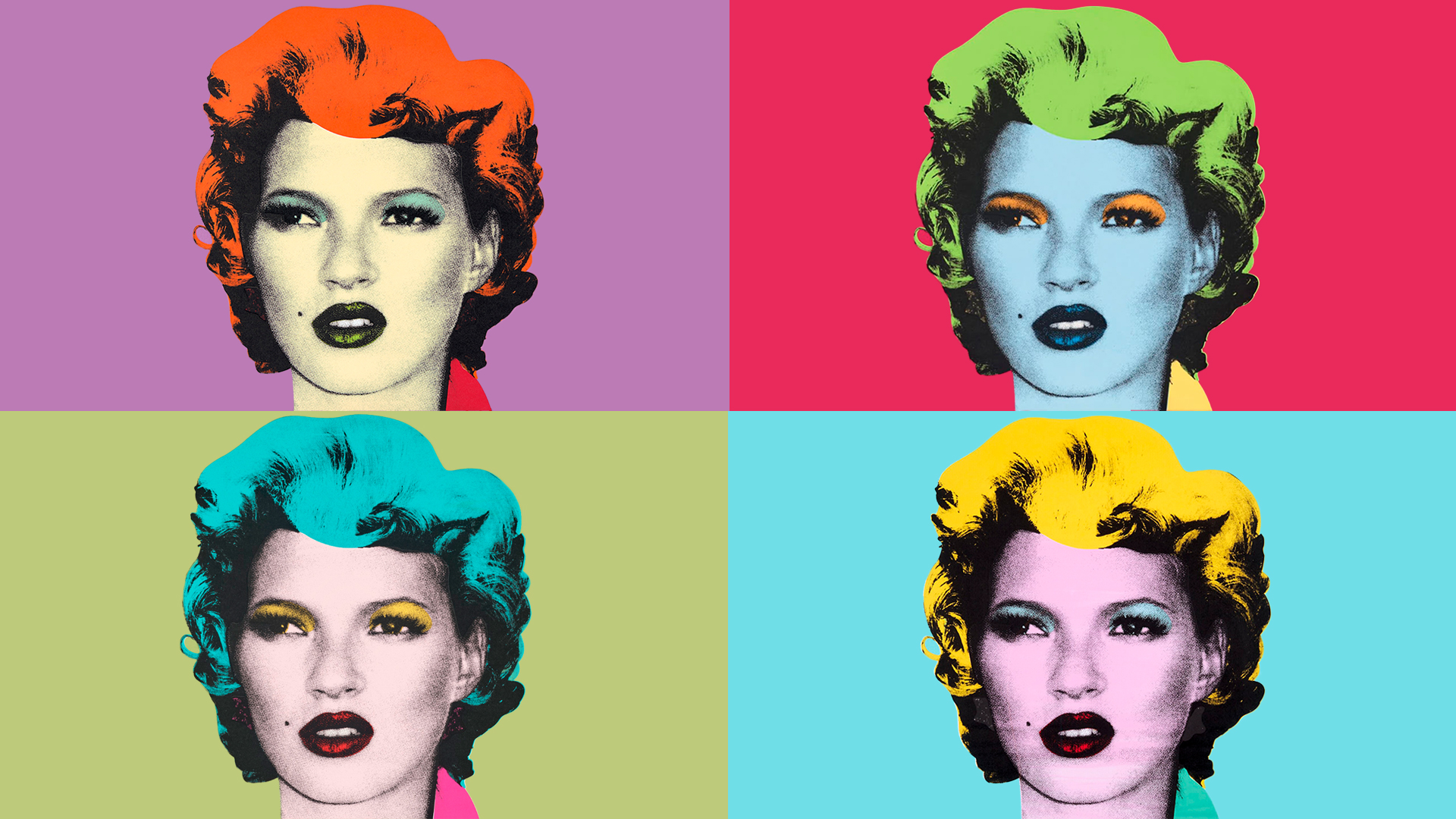
At the heart of the show stood a new interpretation of Andy Warhol’s legendary 1967 Marilyn Monroe screen-print series: Kate Moss.
Banksy re-formulated Warhol’s masterpiece by merging the face of British supermodel Kate Moss with Marilyn’s signature platinum hair and beauty mark, faithfully adopting the original’s radiant aesthetic and composition. The warm honey tones of Marilyn’s hair against the striking cyan background of Kate Moss perfectly embody the colour mastery Warhol had achieved four decades earlier.
Banksy repeats exactly what Warhol did in 1962: he turns the most representative female icon of the era into a mass-produced commodity. The timing is impeccable, 2005 was the year Kate Moss’s cocaine scandal exploded. Her inclusion in Time magazine’s 2007 ‘100 Most Influential People’ list made her the perfect contemporary parallel to Marilyn’s mid-century saturation. Banksy uses this visibility to demonstrate that fame does not stem from individual uniqueness, but from culture endlessly reproducing the same archetype with a new face.
By making Warhol himself part of the subject, Banksy subtly references the Pop artist as the very embodiment of 1960s American consumerism and hyper-capitalism.
Reviving the 1960s Pop style in 2005, Banksy stages a cultural comparison: Marilyn’s Hollywood versus Moss’s supermodel fashion industry. This parallel underlines that advertising still governs celebrity, and that celebrity culture has barely evolved in decades.
The repeated image reflects how icons are now rapidly created, consumed and discarded. By reusing the Pop Art style to question the commodification of celebrity culture, Banksy reveals that today’s cult of fame is built on the same seemingly hollow glamour.
Banksy employs Warhol’s screen-print technique, colour contrast and repetition, yet infuses his own irony. Critics describe it as ‘Pop Art critiqued by Pop Art itself’. It remains one of Banksy’s most influential works to this day.
Released in 2005, Kate Moss signalled a pivotal shift in Banksy’s career, from graffiti provocateur to high-end artist. The series fused his subversive street identity with the official art world, transforming stencil technique into highly valuable, limited-edition screen-prints.
Only 120 copies were produced in six colour variations; Pink, Apricot/Gold, Blue/Grey, Green/Turquoise, Red/Lemon, Purple/Red.
In 2011 Banksy created a special edition as a honeymoon gift for Kate Moss herself; she was stunned to discover the artwork hanging in her hotel bathroom.
Initial sale price was £25,000. Today a single print sells for £150,000 – £300,000, the very ‘cheap consumer object’ Banksy mocked has become one of the most expensive artworks on the market.
Banksy asks us: is fame truly an individual achievement, or merely culture’s endless reproduction of the same archetype with a new face?