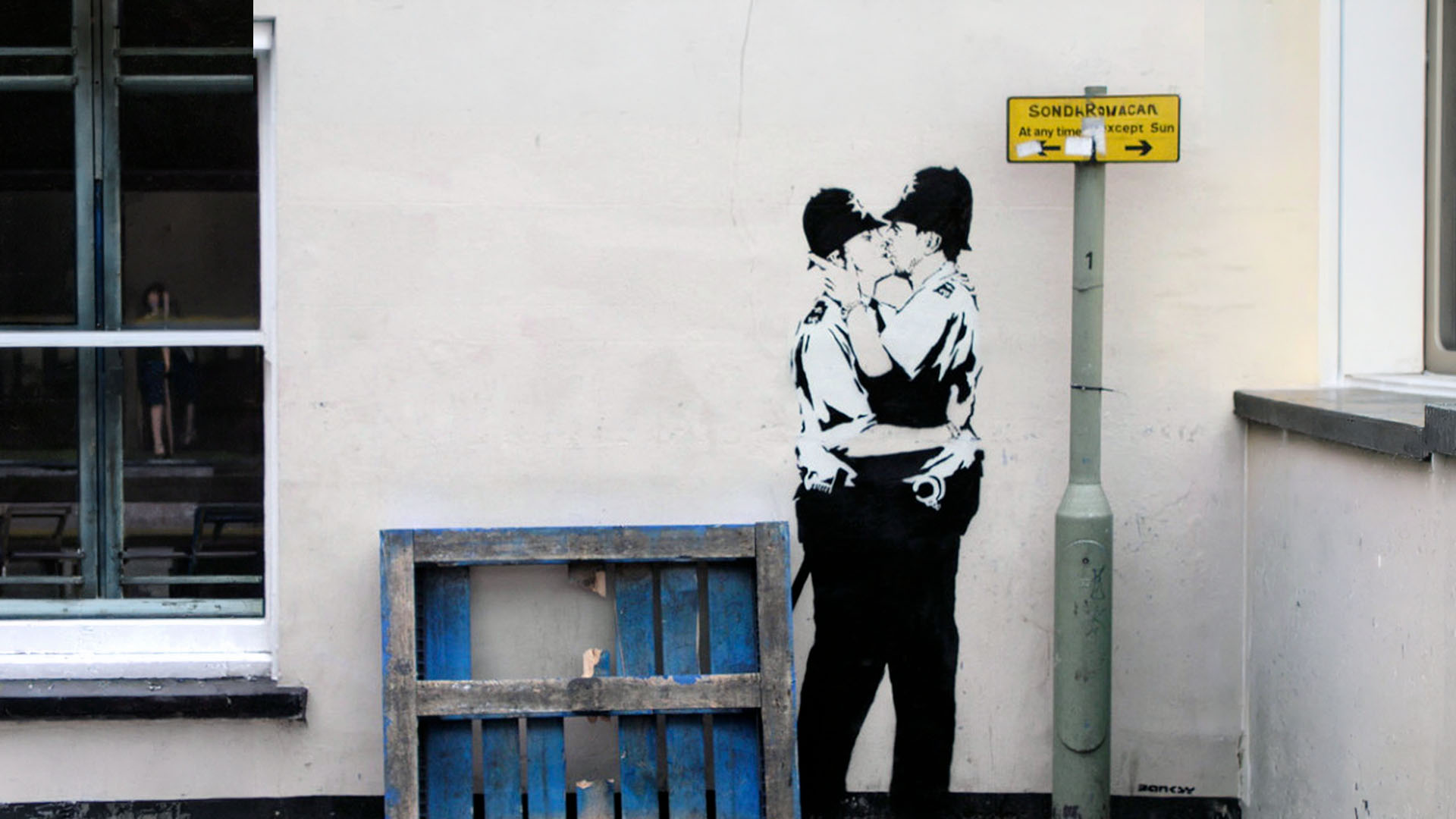
In the colourful, slightly rebellious streets of Brighton, you are looking at one of Banksy’s best loved and longest surviving works: Kissing Coppers.
This stencil, made in 2004 on the outside wall of the Prince Albert Pub in Brighton, shows two male police officers kissing passionately, in full uniform, without even taking off their helmets. In Britain at the time, when same sex marriage was not yet legal, this image was not just surprising. It was a direct, provocative political statement.
The piece quickly drew both local and international attention. It matched Brighton’s LGBTQ+ friendly identity and became one of the city’s symbols. Over time it was protected against repeated attempts at vandalism and covered with a clear perspex panel. In 2011, when the pub changed hands, a major controversy broke out. Reports that the piece might be removed and sold to a private collection caused a strong backlash. In the end, however, the piece stayed in Brighton, and today it can still be seen on the same wall, under protection.
This also makes it one of Banksy’s most enduring survivors among his street works.
In artistic terms, the piece carries one of Banksy’s clearest and least ambiguous messages. It argues that figures of institutional authority are human too, and that love and desire can exist beyond uniform, rank and social expectation.
Today Kissing Copper is both one of Banksy’s most recognisable images and an inseparable part of Brighton’s cultural identity. It has achieved something street art rarely manages. A community embraced it so completely that it became a piece of heritage worth protecting against the corrosive effects of time and vandalism.