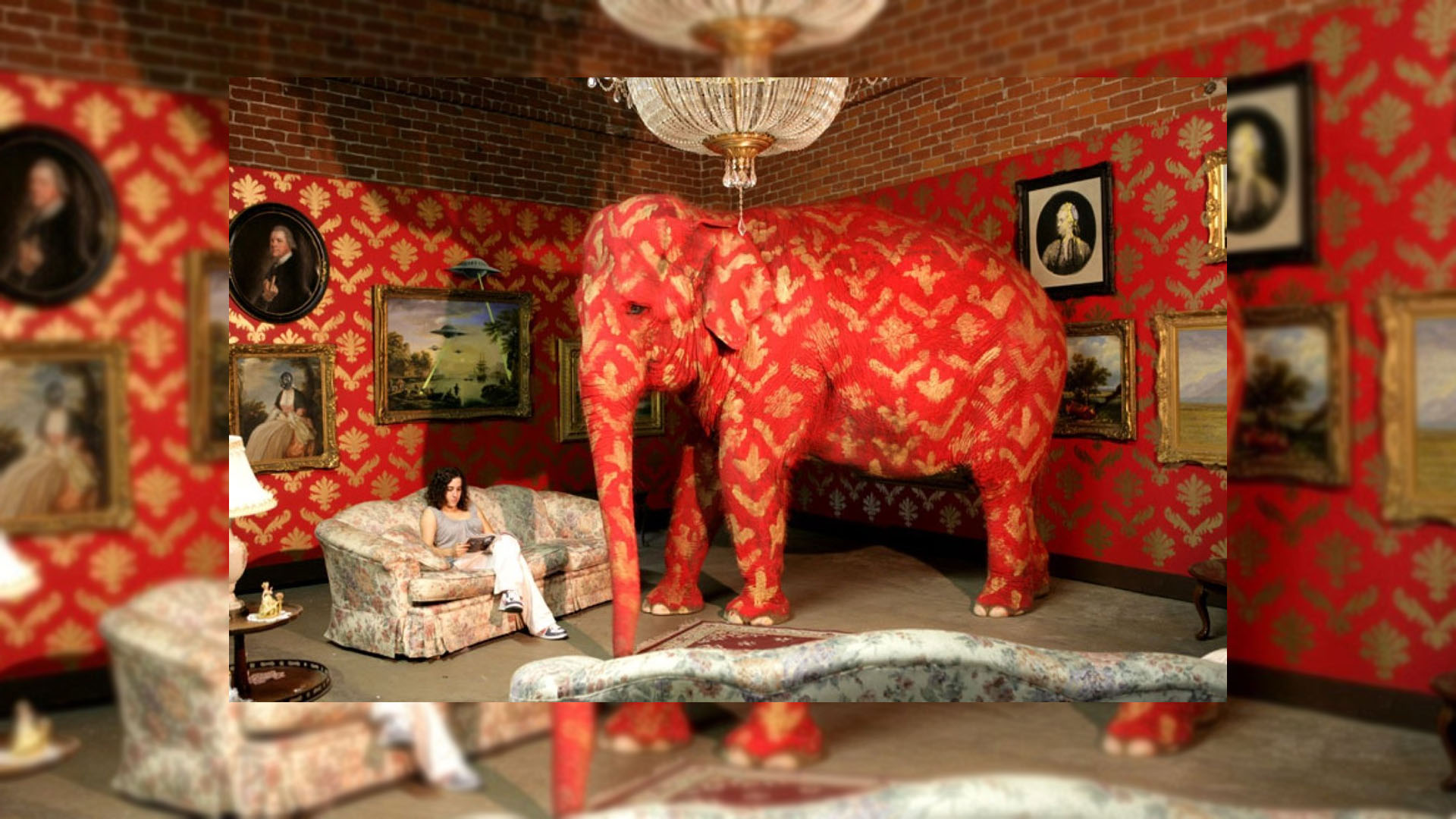
In September 2006, in an abandoned warehouse in Los Angeles, during Banksy’s exhibition “Barely Legal”, visitors were confronted with a scene that startled them completely. A real, living elephant stood in the middle of the exhibition space, painted with a gold gilded wallpaper pattern reminiscent of a Victorian drawing room. The piece was titled “Elephant in the Room”, a direct reference to the phrase used to describe a large problem that everyone can see but avoids discussing.
Banksy’s intention was clear: to bring forward, as an issue “missing” from the art world’s view, the fact that a large part of the world’s population lives on less than a dollar a day.
The piece caused a major controversy. Animal rights organisations, PETA in particular, reacted sharply to a live animal being painted and turned into an exhibition object. In response to this criticism, Banksy explained that the paint used was a harmless, water soluble, organic substance, and that the elephant was washed and safely returned to its owner once the exhibition ended.
So can the piece still be seen today? No. By its very nature it was a temporary installation, existing only for the duration of the exhibition. The warehouse was cleared, the elephant went home, and “Elephant in the Room” today survives only through photographs and news coverage from that time.
This work points to a direction rarely seen in Banksy’s career: the shift from a street wall to a three dimensional, living installation. “Elephant in the Room” is remembered as one of the boldest and most controversial experiments of Banksy’s career.