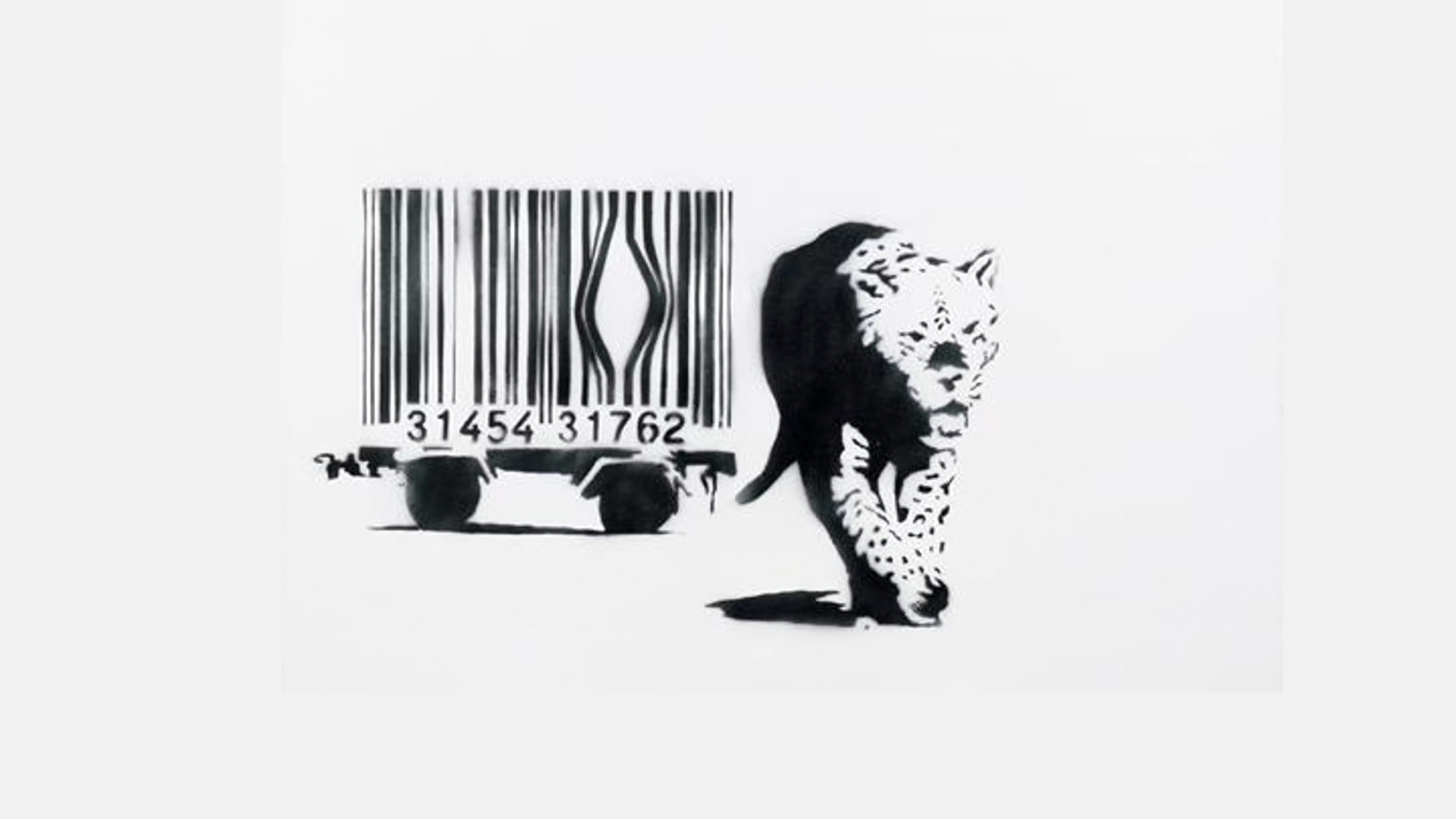
Picture a leopard, not inside a cage, but breaking out of one. And the bars of that cage are actually the vertical lines of a barcode.
That is exactly the composition. A wheeled animal cage has bars made from the lines of a product barcode, and the leopard has bent and twisted them apart to burst out. The bars are broken at the point where the animal passed through.
This distinction matters, because the barcode is not on the animal’s back. Banksy does not label the leopard, he traps it inside the label, and then lets it escape. That difference carries the whole meaning of the piece. The barcode stands for the transformation of a living creature into a priceable product, while the wheeled cage stands for that product’s transportability. Together they draw a line running from the circus to the zoo, from the exotic animal trade to the commodification of nature.
The leopard’s escape shows this system failing. Nature resists being priced.
The piece dates from 2004. It first appeared as a street work in Bristol, on Pembroke Road, and was later produced as a print.
Barcode Leopard is one of Banksy’s most cleverly constructed visual puns. A single graphic element that can be read at once as a price tag and as prison bars is one of the finest examples of the artist’s economy of imagery.