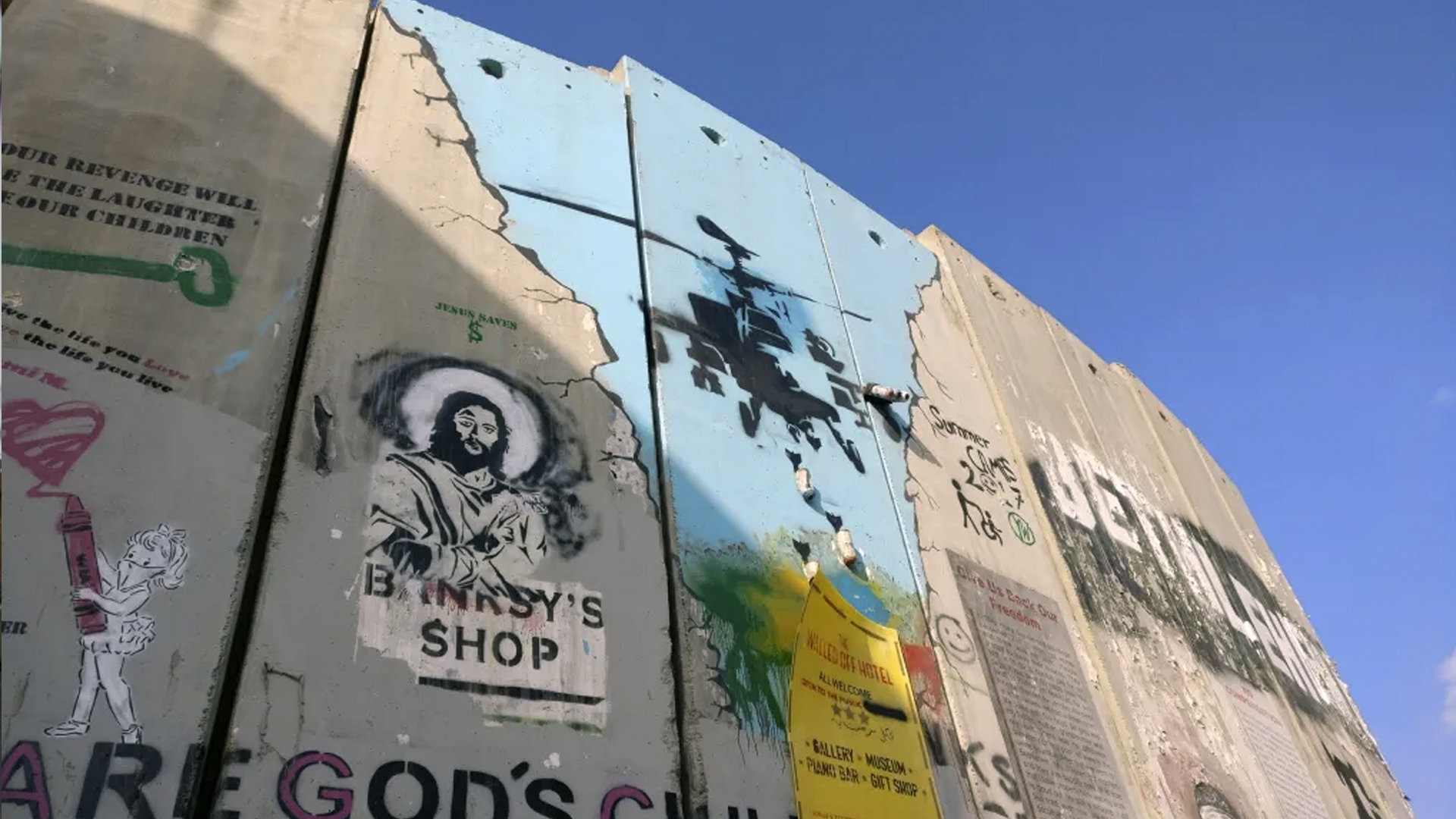
Banksy’s numerous murals painted on the Separation Barrier in Bethlehem in 2005 offer a powerful artistic response to the controversial structure’s physical and symbolic impacts, which Israel began constructing between the occupied West Bank and Israel in 2002.
Israel views the barrier as necessary for national security and preventing attacks, while Palestinians and international observers see it as a tool of segregation, control, and annexation. In 2004, the International Court of Justice ruled its presence in occupied territories as contrary to international law. In urban areas like Bethlehem, the wall rises as a 9-meter-high concrete structure, while in rural regions, it consists of barbed wire, often extending deep into Palestinian land, dividing communities, farmlands, and daily life. Banksy confronts this divisive symbol with ironic and hopeful resistance, using his art to highlight the wall’s absurdity and the struggles faced by Palestinians.
The wall has restricted Palestinian freedom of movement, divided communities, and deeply impacted economic life. Bethlehem, revered as the birthplace of Jesus and a sacred city for Christianity, is also one of the places most affected by the occupation and the wall. Through these murals, Banksy drew international attention to Palestinian hardships, transforming the wall’s gray surface into a canvas of resistance. However, reactions among locals were mixed; one Palestinian told Banksy, “You made the wall beautiful, but we don’t want it beautiful, we hate this wall, go home.” Nevertheless, the murals attracted tourists, bringing alternative tourism to the region. Since 2023, escalating violence in the area has led to increased surveillance infrastructure and military control around the wall, further limiting access and turning the mural areas into militarized zones.
Banksy’s Bethlehem murals are a powerful example of artistic resistance, ironically addressing the absurdity of separation and occupation. The wall’s spatial context amplifies Banksy’s critique. His works bring the tragedy of separation and occupation in Palestine to a global audience, reaffirming the power of art as resistance.
List of Banksy’s Bethlehem Murals
Flying Balloon Girl: Depicts a girl attempting to fly over the wall with balloons, symbolizing the pursuit of freedom.
Girl Frisking a Soldier: Shows a girl frisking a soldier, reversing power dynamics to critique the absurdity of occupation.
Window on the Wall: Presents a colorful beach scene as if the wall were broken, imagining the freedom Palestinians long for.
Armored Dove of Peace: Features a dove in a bulletproof vest, symbolizing the fragility of peace under occupation.
Donkey Documents: Depicts an Israeli soldier checking a donkey’s documents, criticizing the absurd intrusion of occupation into daily life.
Two Boys with Buckets: Shows two boys appearing to play on a beach with buckets, limited by a beach scene visible through a broken wall section, highlighting children’s innocence and the constraints of occupation.
Rage, the Flower Thrower: Portrays a Palestinian throwing a bouquet of flowers, symbolizing peaceful resistance against violence.
Cut It Out: Features scissors and dashed lines cutting through the wall, expressing the desire to dismantle it and symbolizing a longing for freedom.
Boy on a Rock with a Bucket: Depicts a boy with a bucket standing on a rock, with a section of the wall revealing a blue sky and landscape, symbolizing hope and longing for freedom.
Boy with a Ladder: Shows a boy using a ladder to climb over the wall, representing the hope of overcoming barriers.