This piece is one of Banksy’s most personal known works, and as such it stands as an exception within the artist’s entire body of work.
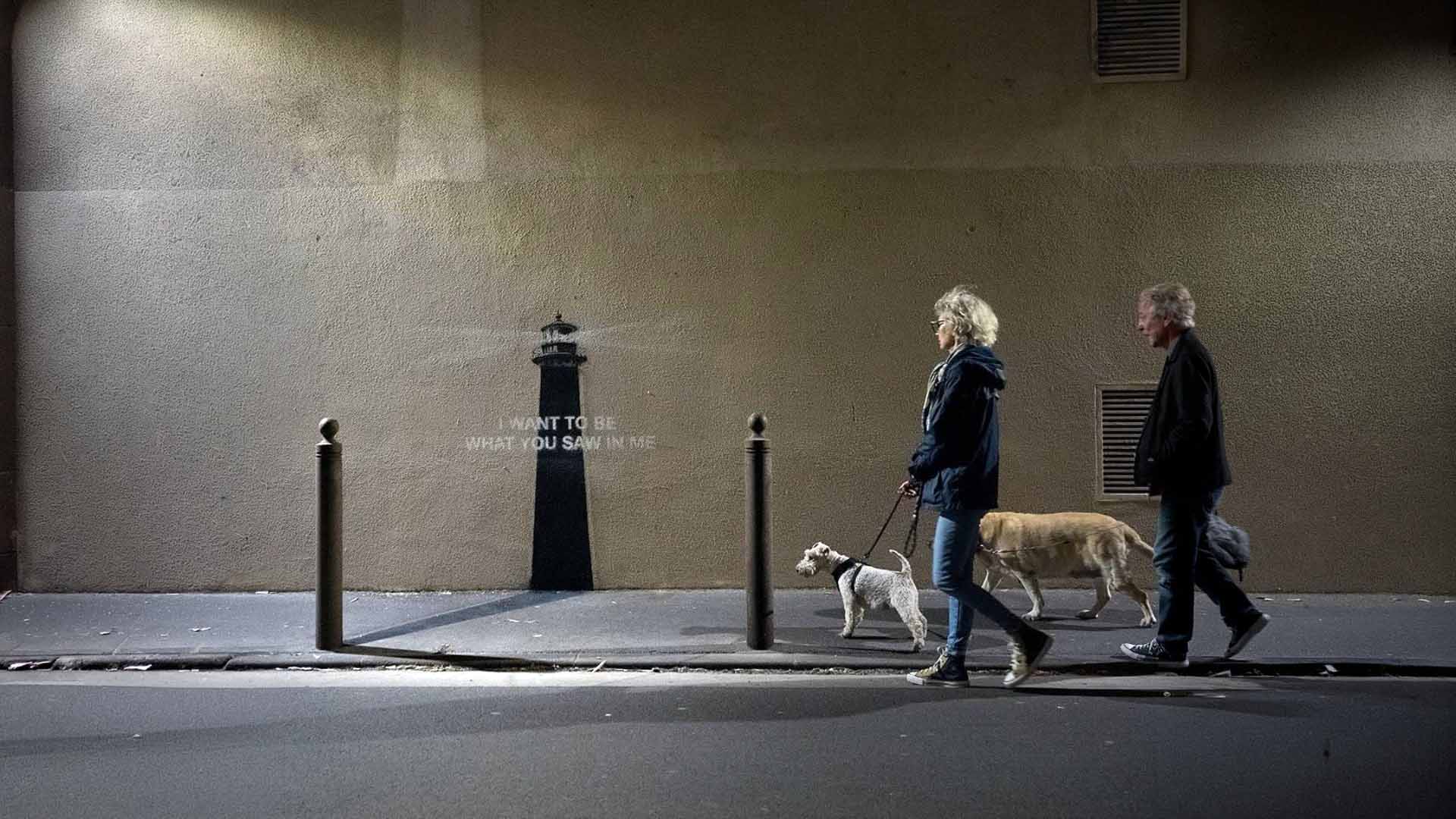
It appeared in May 2025, on a beige wall on Rue Felix Fregier, in a quiet street near the old harbour in Marseille’s 7th arrondissement. After the image circulated online for a few days, Banksy confirmed the piece on 29 May 2025, by posting a single photograph on his official Instagram account, with no caption at all.
On the wall is a lighthouse, made in black stencil technique. But the real skill of the piece begins exactly where the paint stops. The lighthouse’s beam of light is not painted at all. Instead, the shadow of a real steel bollard on the pavement, that short metal post, falls on the wall positioned exactly where the beam should be. In other words, what completes the piece is not paint, but the sun and the street itself.
Beneath the lighthouse, a single sentence is stencilled: “I want to be what you saw in me.”
This sentence is the first known instance of Banksy speaking in the first person on a public wall. Throughout more than twenty years of his career, the language the artist built was always outward facing, aimed at institutions, war, consumerism, the police. Here, for the first time, there is an addressee, and that addressee is not the viewer, but an unnamed “you”.
For this reason, interpretations varied widely. Some critics read the sentence as a declaration of love. Others read it as an apology. Others still read it as a wish to prove oneself. Some commentators suggested that the piece was a statement of political responsibility, connected to the M.V. Louise Michel, the refugee rescue ship Banksy funded. Others, in the opposite direction, criticised the sentence as too sentimental, flirting almost with the language of a motivational poster. As usual, Banksy confirmed none of these readings.
The lighthouse image is open enough to carry all these readings. A lighthouse is a structure that guides the way in the dark, calling the lost one home. At the same time, on the Mediterranean coast, it is a marker standing right in the middle of migration routes. Marseille’s location makes the choice meaningful in this respect too.
According to the latest information, the piece is still in place.
This work is a return to the plainest form of Banksy’s own method: a wall, a shadow, a sentence. But this time the artist appears, for the first time, to be speaking on his own behalf, and that means standing in an unusually vulnerable place for him.