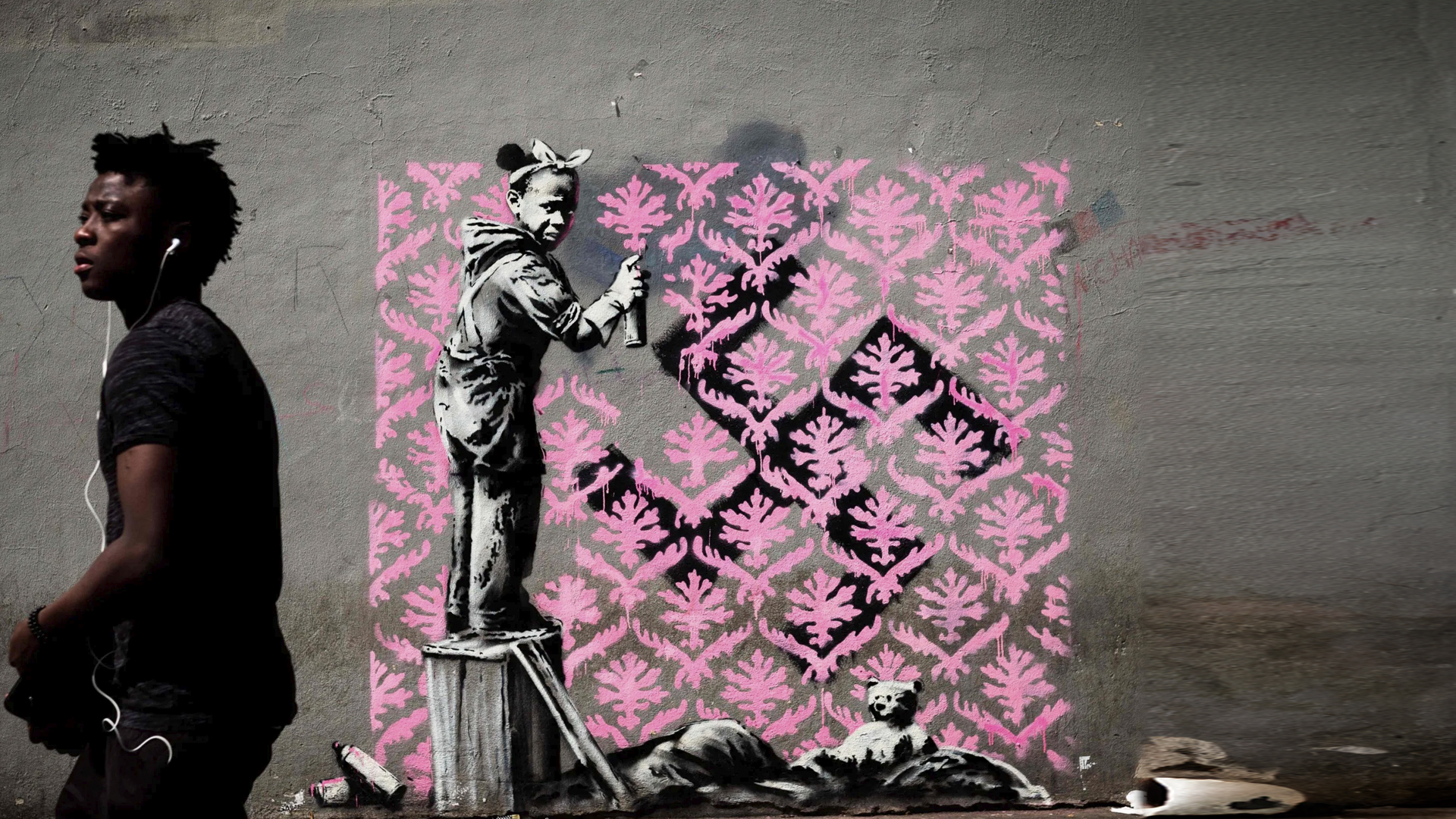
In 2018, Migrant’s Soup Kitchen appeared near Porte de la Chapelle metro station in Paris, on the wall of a migrant soup kitchen, as one of Banksy’s critical murals created around World Refugee Day on June 20.
The mural depicts a young refugee girl, on the ground with her teddy bear, trying to erase a Nazi swastika with a pink pattern. Black-and-white tones create a dramatic effect, while the pink pattern symbolizes hope and resistance. However, vandals later altered the mural to make it seem as if the girl is drawing the symbol; still, Banksy’s intent is clear: to expose the ongoing social and political imbalance affecting displaced populations. Its placement on the soup kitchen wall ensures the message reaches the migrants’ living space directly.
Migrant’s Soup Kitchen conveys Banksy’s critique of the migrant crisis, racist rhetoric, and authorities’ indifference through powerful symbolism. The swastika directly references rising racist prejudices in Europe; the girl’s attempt to erase it with a pink pattern represents innocence, resistance, and hope. Her teddy bear underscores the innocence and vulnerability of refugee children.
In 2018, Emmanuel Macron’s statement in France, “I don’t want migrants in the streets and forests,” led to the closure of refugee centers. Porte de la Chapelle, once home to the “La Bulle” refugee center, was shut down in 2017, leaving hundreds of migrants in makeshift shelters in a dilapidated area.
The mural was strategically placed next to the closed refugee center, seen as a direct critique of Macron’s restrictive migration policies. Paris Mayor Anne Hidalgo praised the mural on Twitter, writing, “Sometimes an image is worth a thousand words. Humanity and pragmatism over populism,” a comment widely interpreted as a response to Macron’s claim that the center attracted migrants to Paris.