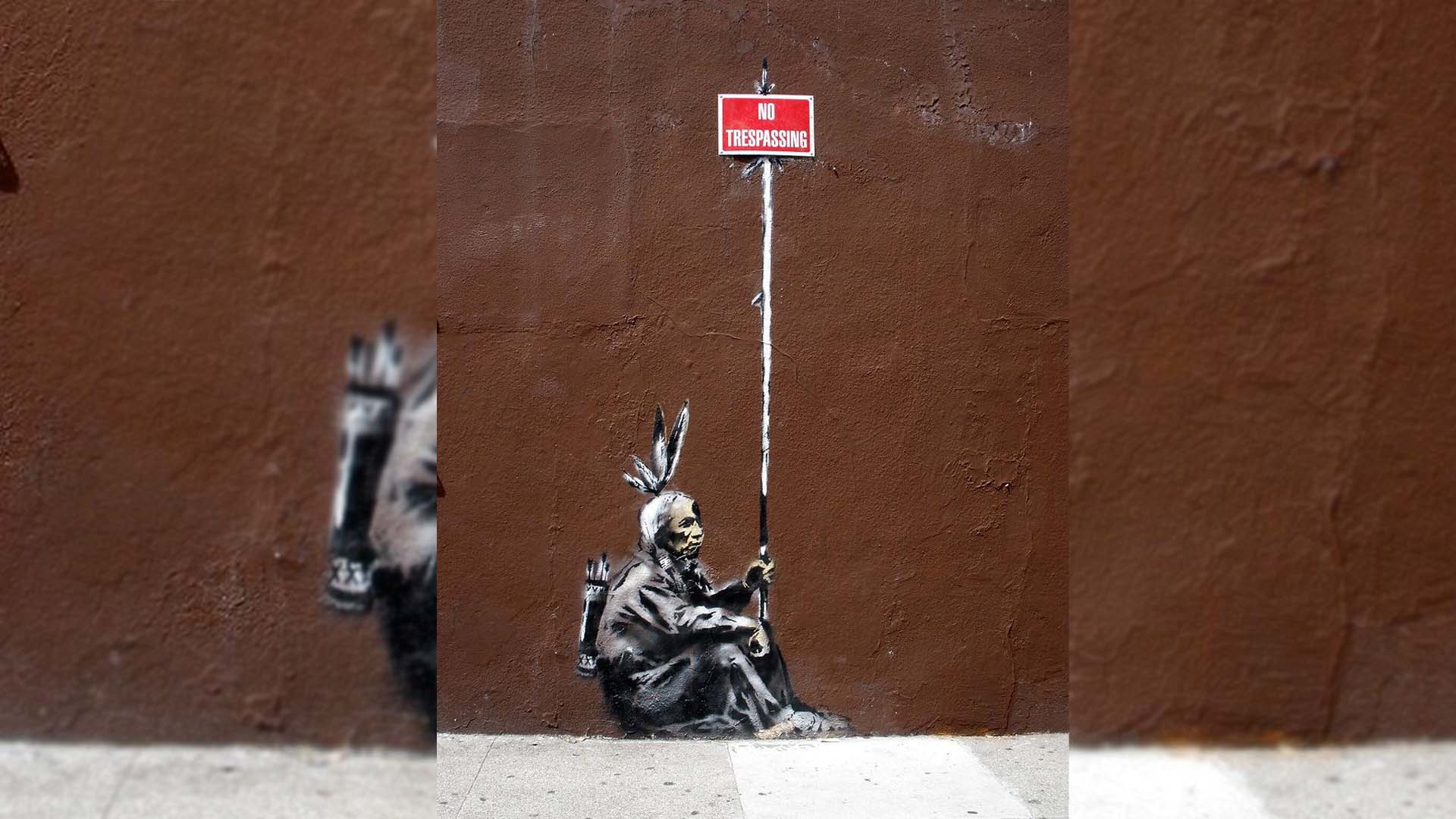
This artwork is one of Banksy’s cleverest uses of an object that was already there on the street, placed right at the centre of the composition.
It appeared in April 2010 in San Francisco’s Mission District, at the corner of Mission Street and Sycamore Street. A seated Native American figure is stencilled on the wall. He is not holding a painted banner. Instead, he holds the pole of a real, official red and white sign that is actually mounted on the wall. It reads: “NO TRESPASSING”.
With this single move, the meaning of the sign flips completely. The same board no longer reads as a property owner’s warning. It reads as a protest banner, held up by the seated figure. And the person holding it represents the peoples of North America whose land was taken from them.
The layers of irony open up here. “No trespassing” is the most basic statement of ownership: this is mine, you cannot enter. Putting that phrase in the hand of someone who represents a people who lost everything to trespassers questions the very idea of ownership, historically. Who trespassed on whose land? And who earned the right to put up that sign, and when?
The piece is one of around six works Banksy left in San Francisco in the spring of 2010. At the time, the artist was active in several American cities to coincide with the US release of his documentary “Exit Through the Gift Shop”.
The piece’s fate followed the typical story of an unprotected street work. Over time other graffiti was added on top, it was covered layer by layer, and eventually painted over completely. No protective measures were taken, and it was never removed from the wall and sold. It simply disappeared where it stood.
That fits oddly well with the piece’s own message. A work that questions a property sign was never protected, precisely because no one held any property rights over it.