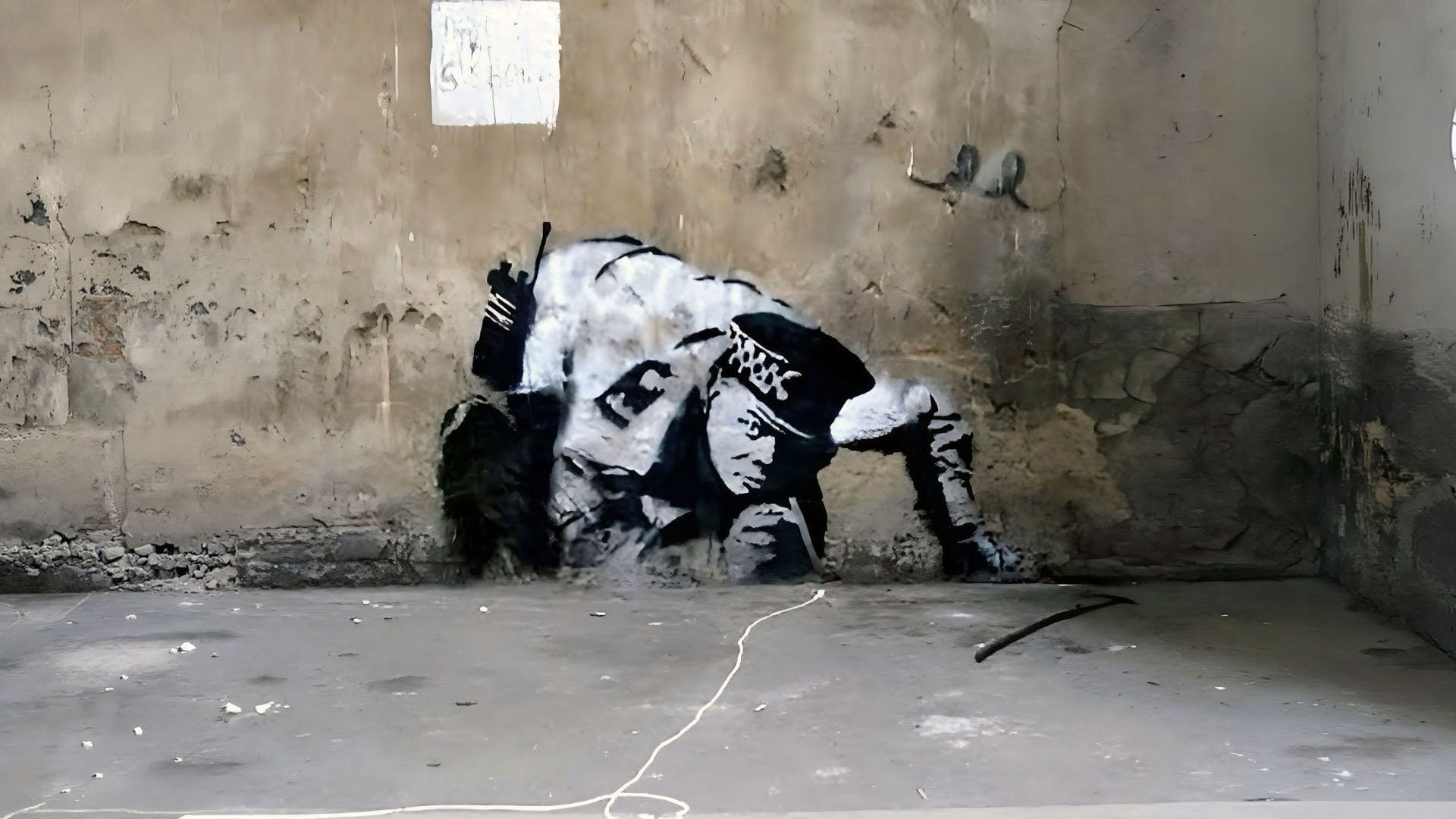
In 2005, a new Banksy piece appeared on the wall of a former public toilet building on Curtain Road in Shoreditch, East London. It showed a uniformed police officer crouching down, bent over as if snorting a line of white powder from the ground, in the style of someone taking cocaine.
The most striking feature of the piece was that the image did not stay confined to the wall. The white paint representing the line of cocaine started at the point where the officer bent over and stretched out into the surrounding streets, spreading for metres like an actual trail of powder. According to sources, a similar second version appeared at Leake Street, near Waterloo Station, where the white line ran for hundreds of metres along the South Bank and remained partly visible until 2008.
A figure whose job is to enforce the law is caught in the middle of one of the clearest possible acts of breaking it. The idea that authority cannot stand outside the order it protects, and that it can sometimes be the very party that violates that order the most, is painted here directly and mockingly.
The fate of the piece was fairly turbulent. The original mural began to be damaged shortly after it appeared, and by 2006 it had been almost completely destroyed by overpainting. According to sources, very little of Banksy’s original stencil remained by that point. After disappearing from view for roughly a decade, the piece resurfaced when developers who bought the building took an interest. The relevant section of brick wall was removed, put through a restoration process lasting nearly sixteen weeks, and reinstalled on the same Curtain Road in October 2017, inside a reinforced glass enclosure, where it was opened to the public.
It should be noted that the version visitors see today is largely a reconstruction of the original 2005 stencil. The protected surface is, in effect, a carefully restored remnant of an image that had been largely worn away over the years.
Snorting Copper stands out as one of Banksy’s most direct criticisms of authority. A theme he returned to often throughout his career, the idea that the watcher can be far more dangerous than the one who needs watching, appears here with sharp irony rather than humour. The physical destruction and reconstruction the piece went through can also be read as a separate story, one that embodies the tension between permanence and impermanence in street art.