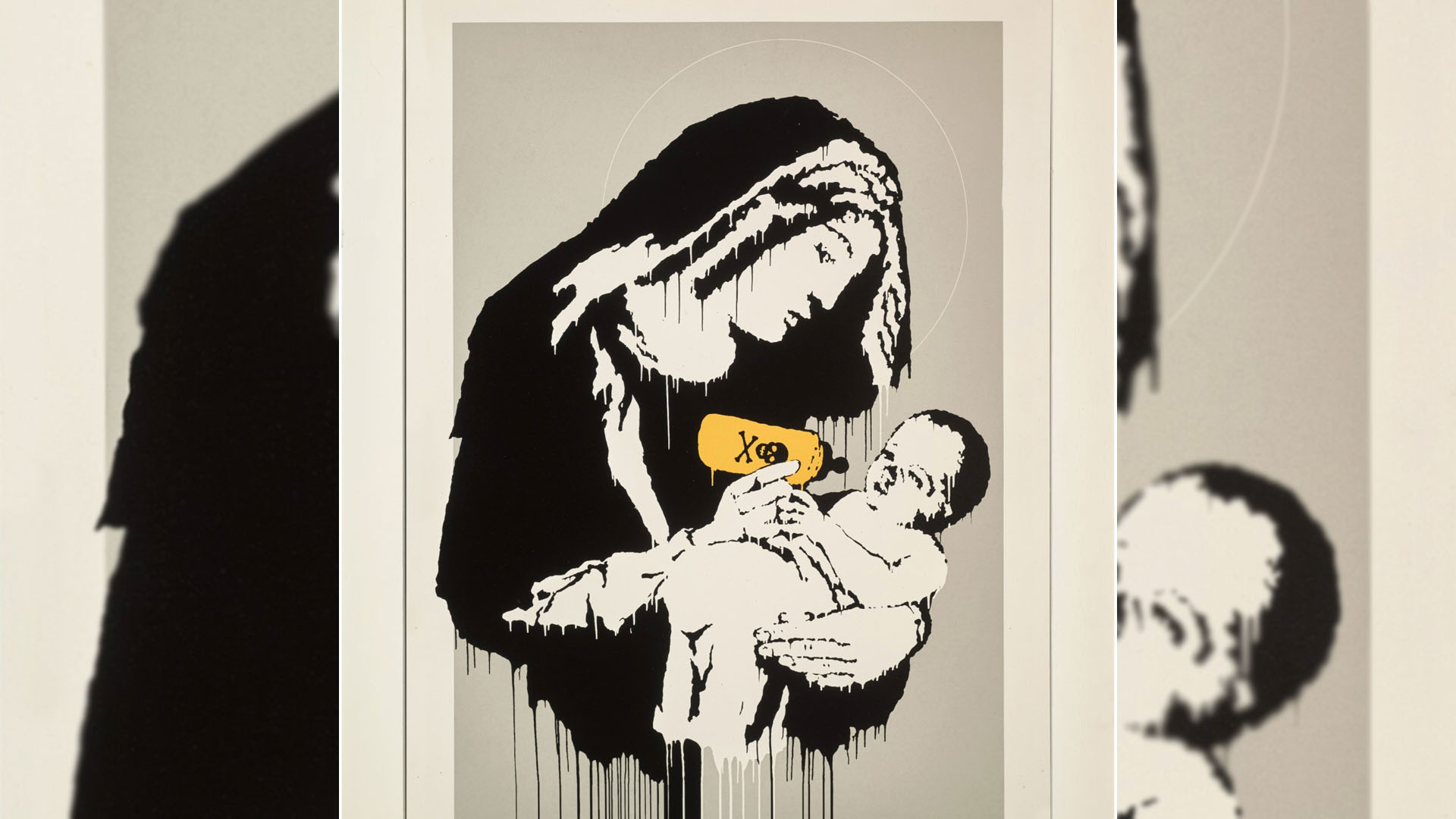
We begin with one of the most repeated scenes in Renaissance painting: the Virgin Mary in classic draped robes, holding a baby in her arms. The pose is familiar from the Madonna compositions of masters such as Raphael.
The only thing that changes is what the baby is drinking. Mary is holding a baby’s bottle, and on it is a skull and crossbones, the sign for poison. The whole composition sits in a dark, flat tone, and the neon yellow bottle is the single bright point among these dead colours.
A second technical detail also carries meaning. The paint runs beyond the edges of the composition, creating the illusion that it is dripping down the paper itself. This dripping, a departure from Banksy’s usual sharp stencil aesthetic, gives the sense that the scene is dissolving, coming apart.
At the centre of the critique is the act of feeding. In culture, a mother’s milk symbolises unconditional care and the continuation of life. Banksy replaces it with poison, questioning what is actually passed down from generation to generation. In the sources, the main reading of the piece rests on religion being handed to a child too young to object, as a tool of social control. The poison here is not about the content of a belief, but about the way it is passed on without question.
The artist uses the same approach in his 2004 work “Christ With Shopping Bags”: undermining a sacred image not by destroying it, but by placing a single modern object inside it.
The piece is a 2003 screenprint. It was published by Pictures on Walls in an edition of 50 signed and 600 unsigned prints, with artist’s proofs produced in red, pink and blue. Its auction record stands at 74,409 pounds, and to date it has gone under the hammer 121 times.