Behind this piece lies one of the strangest coincidences in Banksy’s career, a week in which everything went sideways.
In September 2003, the British band Blur, after their album Think Tank, wanted to work with Banksy for the cover of Observer Music Monthly magazine. The work Banksy had done for the band around that time, including the album cover design, had brought the artist closer to the music world. But before the shoot, Banksy disappeared: according to reports, he had been detained in Berlin on a charge of damaging a building.
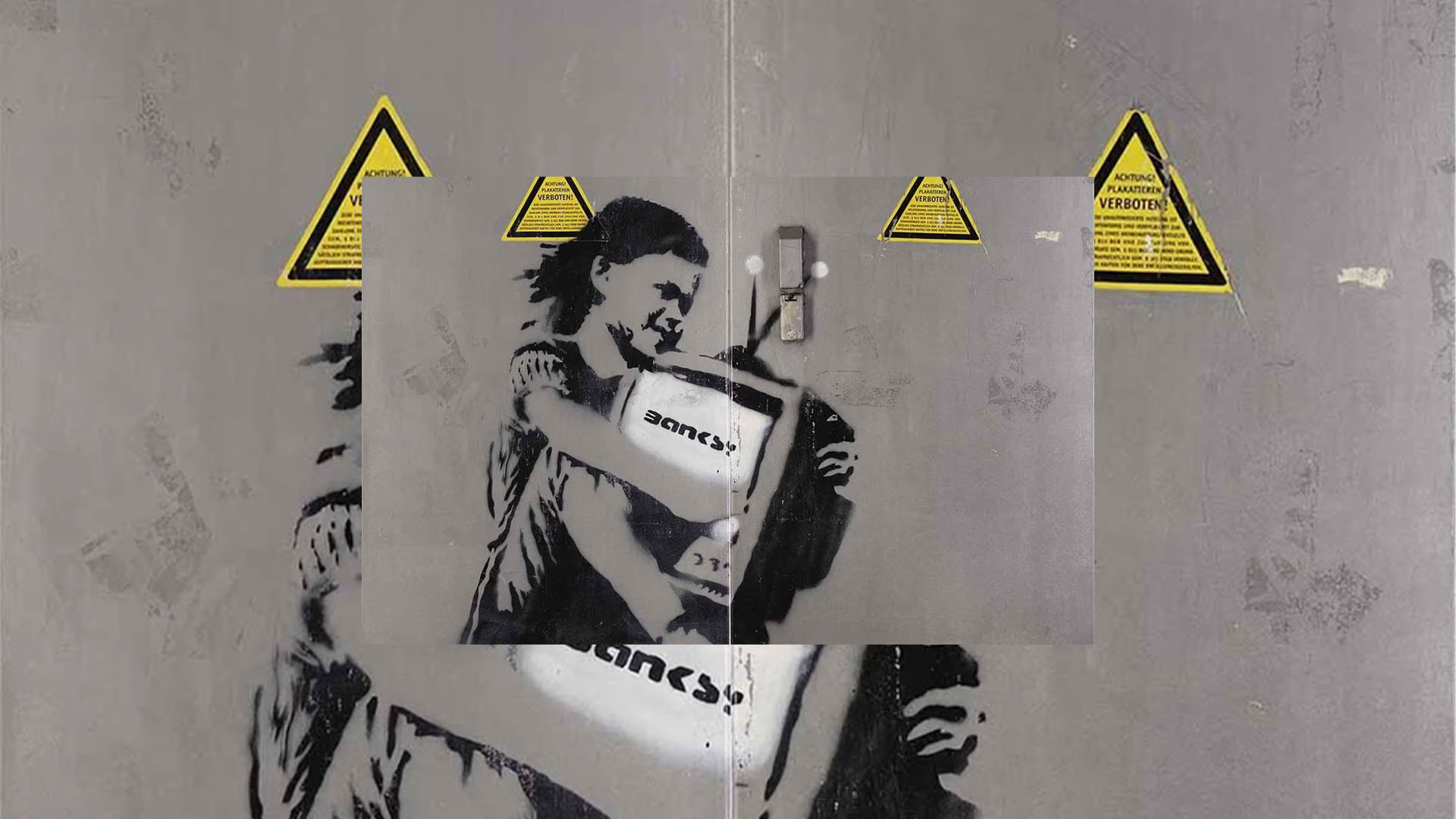
He eventually turned up at the Leeds Festival. A local farmer gave him permission to work on his land, and Banksy produced three separate pieces there. The first was a television seen through a gap in a broken brick wall, and this was the image used on the magazine cover. The other two were made on the metal doors of the farm’s duck house. The piece before you is one of those two.
In the image, a little girl is hugging a television set, almost embracing it. On the screen is a target symbol.
The composition itself carries a tension Banksy returns to often: the relationship between a child and a screen. Here the child is not watching the television, she is hugging it. This suggests the screen has become not an object but a bond, even a friend, and that is exactly what makes it unsettling.
The piece’s survival was no accident, it came down to a decision. Years later, when the duck house was renovated, the landowner removed the doors and kept them rather than throwing them away. In this way, a piece that had been part of a farm structure turned into a portable art object. Sold at auction at Bonhams London on 25 April 2007, the piece fetched 38,400 pounds.
Tv Girl shows that even away from the street, on completely unexpected surfaces, Banksy could speak the same language. A duck house door, a magazine cover and an auction house: the same image, three separate lives.